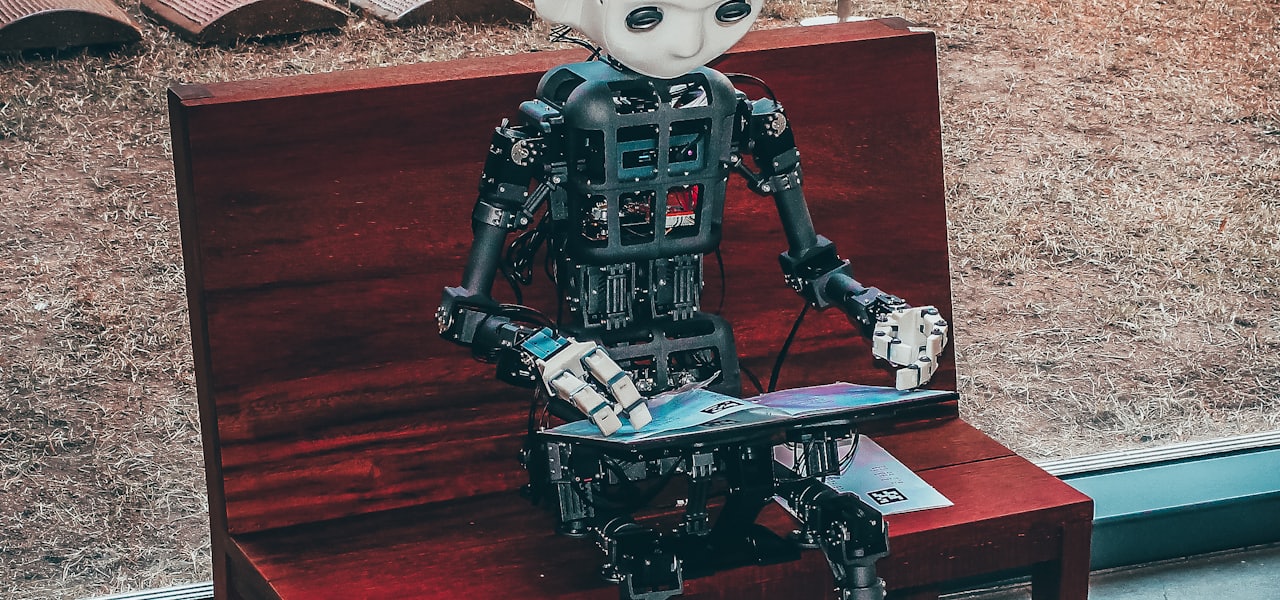
Robotics is the interdisciplinary study and practice of the design, construction, operation, and use of robots. A roboticist is someone who specializes in robotics. Robotics usually combines four aspects of design work: a power source (e.g. a battery), mechanical construction, a control system (electrical circuits), and software (run by remote control or artificial intelligence). The goal of most robotics is to design machines that can assist humans in various fields, such as agriculture, construction, domestic work, food processing, inventory management, manufacturing, medicine, military, mining, space exploration, and transportation. Robots impact humans by displacing workers. Some expect this to occur at an increasing rate, leading to proposed solutions such as basic income. Robotics is itself a lucrative business that creates careers, especially for postgraduates. Roboticists often aim to create machines that seem to interface naturally with humans. The field is under active research and development, with areas of interest including robot kinematics and quantum robotics. == Design == Robotics usually combines four aspects of design work to create a robot: Power source: Potential energy sources include wired electricity, a battery, and/or petrol. Mechanical construction: A physical form or combination of forms is designed to functionally achieve tasks within a given range of environments. This can include locomotive elements such as wheels and caterpillar tracks, as well as hydraulic limbs and manipulators (e.g. hands). Control system: Electrical circuits (utilizing components such as diodes and transistors) are used to run software, govern motor movement, and read sensors. Software: A program is how a robot decides when or how to do something. Robotic programs can be run by remote control, artificial intelligence (AI), or a hybrid of the two. AI programming is an important part of robotic navigation and human–robot interaction. === Power source === Many different types of batteries can be used as a power source. Most are lead–acid batteries, which are safe and have relatively long shelf lives but are rather heavy compared to silver–cadmium batteries, which are much smaller in volume and much more expensive. Designing a battery-powered robot needs to take into account factors such as safety, cycle lifetime, and weight. Generators, often some type of internal combustion engine, can also be used, but are often mechanically complex and inefficient. Additionally, a tether could connect the robot to a power supply, saving weight and space, but requiring a cumbersome cable. Potential power sources include: Flywheel energy storage Hydraulics Nuclear Organic garbage (through anaerobic digestion) Pneumatics (compressed gases) Solar power === Mechanical construction === Actuators are the "muscles" of a robot, the parts which convert stored energy into movement. The most popular actuators are electric motors that rotate a wheel or gear and linear actuators that control factory robots. Most robots use electric motors—often brushed and brushless DC motors in portable robots or AC motors in industrial robots and computer numerical control machines—especially in systems with lighter loads and where the predominant form of motion is rotational. Meanwhile, linear actuators move in and out and often have quicker direction changes, particularly when large forces are needed, such as with industrial robotics. They are typically powered by oil or compressed air, but can also be powered by electricity, usually via a motor and a leadscrew. The mechanical rack and pinion is common. Recent alternatives to DC motors are piezoelectric motors, including ultrasonic motors, in which tiny piezoceramic elements vibrate many thousands of times per second, causing linear or rotary motion. One type uses the vibration of the piezo elements to step the motor in a circle or a straight line; another type uses the piezo elements to vibrate a nut or drive a screw. The advantages of these motors are nanometer resolution, speed, and force for their size. Series elastic actuation (SEA) relies on introducing intentional elasticity between the motor actuator and the load for robust force control. Due to the resultant lower reflected inertia, series elastic actuation improves safety during robot interactions or collisions. Further, it provides energy efficiency and shock absorption (mechanical filtering) while reducing excessive wear on the transmission and other components. This approach has successfully been employed in various robots, particularly advanced manufacturing robots and walking humanoid robots. The controller design of a series elastic actuator is most often performed within the passivity framework as it ensures the safety of interaction with unstructured environments. However, this framework suffers from stringent limitations imposed on the controller, which may impact performance. Pneumatic artificial muscles, also known as air muscles, are special tubes that expand (typically up to 42%) when air is forced inside them; they are used in some robot applications. Muscle wire, also known as shape memory alloy, is a material that contracts (under 5%) when electricity is applied; they have been used for some small robots. Electroactive polymers are a plastic material that can contract substantially (up to 380% activation strain) from electricity and have been used in the facial muscles and arms of humanoid robots, as well as to enable new robots to float, fly, swim or walk. Additionally, elastic carbon nanotubes are a promising experimental artificial muscle technology. The absence of defects in carbon nanotubes enables these filaments to deform elastically by several percent, with energy storage levels of perhaps 10 J/cm3 for metal nanotubes. Human biceps could be replaced with wire of this material measuring 8 millimetres (3⁄8 in) in diameter, feasibly allowing future robots to outperform humans. ==== Locomotion ==== Robots with only one or two wheel(s) can have advantages such as greater efficiency, reduced parts, and navigation through confined areas. A one-wheeled robot balances on a round ball; Carnegie Mellon University's Ballbot is the approximate height and width of a person. Several attempts have also been made to build spherical robots (also known as orb bots or ball bots), which move by spinning a weight inside the ball or rotating outer shells. Two-wheeled balancing robots generally use a gyroscope to detect how much a robot is falling and drive the wheels proportionally up to hundreds of times per second to counterbalance the fall, based on inverted pendulum dynamics. NASA's Robonaut has been mounted to a Segway for a similar effect. Most mobile robots have four wheels or continuous tracks. Six wheels can give better traction in outdoor terrain, while tracks provide even more grip. Tracked wheels are common for outdoor off-road robots, but are difficult to use indoors. A small number of skating robots have been developed, one of which is a multimodal walking and skating device with four legs and unpowered wheels. Several robots have been made that can walk on two legs, but not yet as reliably as a human. Many other robots have been built that walk on more than two legs, being significantly easier. Walking robots could be used for uneven terrains, providing a high degree of mobility and efficiency, but two-legged robots can currently only handle flat floors or perhaps stairs. Some approaches have included: The zero moment point (ZMP) is the algorithm used by robots such as Honda's ASIMO. The robot's onboard computer tries to keep the total inertial forces (the combination of Earth's gravity and the acceleration and deceleration of walking) exactly opposed by the floor reaction force (the force of the floor pushing back on the robot's foot). In this way, the two forces cancel out, leaving no moment (force causing the robot to rotate and fall over). Human observers note that this is not exactly how a human walks, with some describing ASIMO's walk as looking like it needs use the bathroom. ASIMO's walking algorithm utilizes some dynamic balancing, but requires a flat surface. Several robots, built in the 1980s by Marc Raibert at the MIT Leg Laboratory, successfully demonstrated very dynamic walking. Initially, a robot with only one leg, and a very small foot could stay upright simply by hopping. The movement is the same as that of a person on a pogo stick. As the robot falls to one side, it would jump slightly in that direction to catch itself. Soon, the algorithm was generalized to two and four legs. A bipedal robot was demonstrated running and even performing somersaults. A quadruped was also demonstrated which could trot, run, pace, and bound. A more advanced approach is a dynamic balancing algorithm, which constantly monitors the robot's motion and places the feet to maintain stability. This technique has been demonstrated by Anybots' Dexter robot (
Software configuration management
Software configuration management (SCM), a.k.a. software change and configuration management (SCCM), is the software engineering practice of tracking and controlling changes to a software system. It is part of the larger cross-disciplinary field of configuration management (CM). SCM includes version control and the establishment of baselines. == Goals == The goals of SCM include: Configuration identification - Identifying configurations, configuration items and baselines. Configuration control - Implementing a controlled change process. This is usually achieved by setting up a change control board whose primary function is to approve or reject all change requests that are sent against any baseline. Configuration status accounting - Recording and reporting all the necessary information on the status of the development process. Configuration auditing - Ensuring that configurations contain all their intended parts and are sound with respect to their specifying documents, including requirements, architectural specifications and user manuals. Build management - Managing the process and tools used for builds. Process management - Ensuring adherence to the organization's development process. Environment management - Managing the software and hardware that host the system. Teamwork - Facilitate team interactions related to the process. Defect tracking - Making sure every defect has traceability back to the source. With the introduction of cloud computing and DevOps the purposes of SCM tools have become merged in some cases. The SCM tools themselves have become virtual appliances that can be instantiated as virtual machines and saved with state and version. The tools can model and manage cloud-based virtual resources, including virtual appliances, storage units, and software bundles. The roles and responsibilities of the actors have become merged as well with developers now being able to dynamically instantiate virtual servers and related resources. == History == == Examples == Ansible – Open-source software platform for remote configuring and managing computers CFEngine – Configuration management software Chef – Configuration management toolPages displaying short descriptions of redirect targets LCFG – Computer configuration management system NixOS – Linux distribution OpenMake Software – DevOps company Otter Puppet – Open source configuration management software Salt – Configuration management software Rex – Open source software
Hierarchical RBF
In computer graphics, hierarchical RBF is an interpolation method based on radial basis functions (RBFs). Hierarchical RBF interpolation has applications in treatment of results from a 3D scanner, terrain reconstruction, and the construction of shape models in 3D computer graphics (such as the Stanford bunny, a popular 3D model). This problem is informally named as "large scattered data point set interpolation." == Method == The steps of the interpolation method (in three dimensions) are as follows: Let the scattered points be presented as set P = { c i = ( x i , y i , z i ) | i = 1 N ⊂ R 3 } {\displaystyle \mathbf {P} =\{\mathbf {c} _{i}=(\mathbf {x} _{i},\mathbf {y} _{i},\mathbf {z} _{i})\vert _{i=1}^{N}\subset \mathbb {R} ^{3}\}} Let there exist a set of values of some function in scattered points H = { h i | i = 1 N ⊂ R } {\displaystyle \mathbf {H} =\{\mathbf {h} _{i}\vert _{i=1}^{N}\subset \mathbb {R} \}} Find a function f ( x ) {\displaystyle \mathbf {f} (\mathbf {x} )} that will meet the condition f ( x ) = 1 {\displaystyle \mathbf {f} (\mathbf {x} )=1} for points lying on the shape and f ( x ) ≠ 1 {\displaystyle \mathbf {f} (\mathbf {x} )\neq 1} for points not lying on the shape As J. C. Carr et al. showed, this function takes the form f ( x ) = ∑ i = 1 N λ i φ ( x , c i ) {\displaystyle \mathbf {f} (\mathbf {x} )=\sum _{i=1}^{N}\lambda _{i}\varphi (\mathbf {x} ,\mathbf {c} _{i})} where φ {\displaystyle \varphi } is a radial basis function and λ {\displaystyle \lambda } are the coefficients that are the solution of the following linear system of equations: [ φ ( c 1 , c 1 ) φ ( c 1 , c 2 ) . . . φ ( c 1 , c N ) φ ( c 2 , c 1 ) φ ( c 2 , c 2 ) . . . φ ( c 2 , c N ) . . . . . . . . . . . . φ ( c N , c 1 ) φ ( c N , c 2 ) . . . φ ( c N , c N ) ] ∗ [ λ 1 λ 2 . . . λ N ] = [ h 1 h 2 . . . h N ] {\displaystyle {\begin{bmatrix}\varphi (c_{1},c_{1})&\varphi (c_{1},c_{2})&...&\varphi (c_{1},c_{N})\\\varphi (c_{2},c_{1})&\varphi (c_{2},c_{2})&...&\varphi (c_{2},c_{N})\\...&...&...&...\\\varphi (c_{N},c_{1})&\varphi (c_{N},c_{2})&...&\varphi (c_{N},c_{N})\end{bmatrix}}{\begin{bmatrix}\lambda _{1}\\\lambda _{2}\\...\\\lambda _{N}\end{bmatrix}}={\begin{bmatrix}h_{1}\\h_{2}\\...\\h_{N}\end{bmatrix}}} For determination of surface, it is necessary to estimate the value of function f ( x ) {\displaystyle \mathbf {f} (\mathbf {x} )} in specific points x. A lack of such method is a considerable complication on the order of O ( n 2 ) {\displaystyle \mathbf {O} (\mathbf {n} ^{2})} to calculate RBF, solve system, and determine surface. == Other methods == Reduce interpolation centers ( O ( n 2 ) {\displaystyle \mathbf {O} (\mathbf {n} ^{2})} to calculate RBF and solve system, O ( m n ) {\displaystyle \mathbf {O} (\mathbf {m} \mathbf {n} )} to determine surface) Compactly support RBF ( O ( n log n ) {\displaystyle \mathbf {O} (\mathbf {n} \log {\mathbf {n} })} to calculate RBF, O ( n 1.2..1.5 ) {\displaystyle \mathbf {O} (\mathbf {n} ^{1.2..1.5})} to solve system, O ( m log n ) {\displaystyle \mathbf {O} (\mathbf {m} \log {\mathbf {n} })} to determine surface) FMM ( O ( n 2 ) {\displaystyle \mathbf {O} (\mathbf {n} ^{2})} to calculate RBF, O ( n log n ) {\displaystyle \mathbf {O} (\mathbf {n} \log {\mathbf {n} })} to solve system, O ( m + n log n ) {\displaystyle \mathbf {O} (\mathbf {m} +\mathbf {n} \log {\mathbf {n} })} to determine surface) == Hierarchical algorithm == A hierarchical algorithm allows for an acceleration of calculations due to decomposition of intricate problems on the great number of simple (see picture). In this case, hierarchical division of space contains points on elementary parts, and the system of small dimension solves for each. The calculation of surface in this case is taken to the hierarchical (on the basis of tree-structure) calculation of interpolant. A method for a 2D case is offered by Pouderoux J. et al. For a 3D case, a method is used in the tasks of 3D graphics by W. Qiang et al. and modified by Babkov V.
Videotex
Videotex (or interactive videotex) was one of the earliest implementations of an end-user information system. From the late 1970s to early 2010s, it was used to deliver information (usually pages of text) to a user in computer-like format, typically to be displayed on a television or a dumb terminal. In a strict definition, videotex is any system that provides interactive content and displays it on a video monitor such as a television, typically using modems to send data in both directions. A close relative is teletext, which sends data in one direction only, typically encoded in a television signal. All such systems are occasionally referred to as viewdata. Unlike the modern Internet, traditional videotex services were highly centralized. Videotex in its broader definition can be used to refer to any such service, including teletext, the Internet, bulletin board systems, online service providers, and even the arrival/departure displays at an airport. This usage is no longer common. With the exception of Minitel in France, videotex elsewhere never managed to attract any more than a very small percentage of the universal mass market once envisaged. By the end of the 1980s its use was essentially limited to a few niche applications. == Initial development and technologies == === United Kingdom === The first attempts at a general-purpose videotex service were created in the United Kingdom in the late 1960s. In about 1970 the BBC had a brainstorming session in which it was decided to start researching ways to send closed captioning information to the audience. As the Teledata research continued the BBC became interested in using the system for delivering any sort of information, not just closed captioning. In 1972, the concept was first made public under the new name Ceefax. Meanwhile, the General Post Office (soon to become British Telecom) had been researching a similar concept since the late 1960s, known as Viewdata. Unlike Ceefax which was a one-way service carried in the existing TV signal, Viewdata was a two-way system using telephones. Since the Post Office owned the telephones, this was considered to be an excellent way to drive more customers to use the phones. Not to be outdone by the BBC, they also announced their service, under the name Prestel. ITV soon joined the fray with a Ceefax-clone known as ORACLE. In 1974, all the services agreed on a standard for displaying the information. The display would be a simple 40×24 grid of text, with some "graphics characters" for constructing simple graphics, revised and finalized in 1976. The standard did not define the delivery system, so both Viewdata-like and Teledata-like services could at least share the TV-side hardware, which was expensive at the time. The standard also introduced a new term that covered all such services, teletext. Ceefax first started operation in 1974 with a limited 30 pages, followed quickly by ORACLE and then Prestel in 1979. By 1981, Prestel International was available in nine countries, and a number of countries, including Sweden, The Netherlands, Finland and West Germany were developing their own national systems closely based on Prestel. General Telephone and Electronics (GTE) acquired an exclusive agency for the system for North America. In the early 1980s, videotex became the base technology for the London Stock Exchange's pricing service called TOPIC. Later versions of TOPIC, notably TOPIC2 and TOPIC3, were developed by Thanos Vassilakis and introduced trading and historic price feeds. === France === Development of a French teletext-like system began in 1973. A very simple 2-way videotex system called Tictac was also demonstrated in the mid-1970s. As in the UK, this led on to work to develop a common display standard for videotex and teletext, called Antiope, which was finalised in 1977. Antiope had similar capabilities to the UK system for displaying alphanumeric text and chunky "mosaic" character-based block graphics. A difference however was that while in the UK standard control codes automatically also occupied one character position on screen, Antiope allowed for "non spacing" control codes. This gave Antiope slightly more flexibility in the use of colours in mosaic block graphics, and in presenting the accents and diacritics of the French language. Meanwhile, spurred on by the 1978 Nora/Minc report, the French government was determined to catch up on a perceived falling behind in its computer and communications facilities. In 1980 it began field trials issuing Antiope-based terminals for free to over 250,000 telephone subscribers in Ille-et-Vilaine region, where the French CCETT research centre was based, for use as telephone directories. The trial was a success, and in 1982 Minitel was rolled out nationwide. === Canada === Since 1970, researchers at the Communications Research Centre (CRC) in Ottawa had been working on a set of "picture description instructions", which encoded graphics commands as a text stream. Graphics were encoded as a series of instructions (graphics primitives) each represented by a single ASCII character. Graphic coordinates were encoded in multiple 6 bit strings of XY coordinate data, flagged to place them in the printable ASCII range so that they could be transmitted with conventional text transmission techniques. ASCII SI/SO characters were used to differentiate the text from graphic portions of a transmitted "page". In 1975, the CRC gave a contract to Norpak to develop an interactive graphics terminal that could decode the instructions and display them on a colour display, which was successfully up and running by 1977. Against the background of the developments in Europe, CRC was able to persuade the Canadian government to develop the system into a fully-fledged service. In August 1978, the Canadian Department of Communications publicly launched it as Telidon, a "second generation" videotex/teletext service, and committed to a four-year development plan to encourage rollout. Compared to the European systems, Telidon offered real graphics, as opposed to block-mosaic character graphics. The downside was that it required much more advanced decoders, typically featuring Zilog Z80 or Motorola 6809 processors. === Japan === Research in Japan was shaped by the demands of the large number of Kanji characters used in Japanese script. With 1970s technology, the ability to generate so many characters on demand in the end-user's terminal was seen as prohibitive. Instead, development focussed on methods to send pages to user terminals pre-rendered, using coding strategies similar to facsimile machines. This led to a videotex system called Captain ("Character and Pattern Telephone Access Information Network"), created by NTT in 1978, which went into full trials from 1979 to 1981. The system also lent itself naturally to photographic images, albeit at only moderate resolution. However, the pages typically took two or three times longer to load, compared to the European systems. NHK developed an experimental teletext system along similar lines, called CIBS ("Character Information Broadcasting Station"). Based on a 388×200 pixel resolution, it was first announced in 1976, and began trials in late 1978. (NHK's ultimate production teletext system launched in 1983). == Standards == Work to establish an international standard for videotex began in 1978 in CCITT. But the national delegations showed little interest in compromise, each hoping that their system would come to define what was perceived to be going to be an enormous new mass-market. In 1980 CCITT therefore issued recommendation S.100 (later T.100), noting the points of similarity but the essential incompatibility of the systems, and declaring all four to be recognised options. Trying to kick-start the market, AT&T Corporation entered the fray, and in May 1981 announced its own Presentation Layer Protocol (PLP). This was closely based on the Canadian Telidon system, but added to it some further graphics primitives and a syntax for defining macros, algorithms to define cleaner pixel spacing for the (arbitrarily sizeable) text, and also dynamically redefinable characters and a mosaic block graphic character set, so that it could reproduce content from the French Antiope. After some further revisions this was adopted in 1983 as ANSI standard X3.110, more commonly called NAPLPS, the North American Presentation Layer Protocol Syntax. It was also adopted in 1988 as the presentation-layer syntax for NABTS, the North American Broadcast Teletext Specification. Meanwhile, the European national Postal Telephone and Telegraph (PTT) agencies were also increasingly interested in videotex, and had convened discussions in European Conference of Postal and Telecommunications Administrations (CEPT) to co-ordinate developments, which had been diverging along national lines. As well as the British and French standards, the Swedes had proposed extending the British Prestel standard with a new se
SMBGhost
SMBGhost (or SMBleedingGhost or CoronaBlue) is a type of security vulnerability, with wormlike features, that affects Windows 10 computers and was first reported publicly on 10 March 2020. == Security vulnerability == A proof of concept (PoC) exploit code was published 1 June 2020 on GitHub by a security researcher. The code could possibly spread to millions of unpatched computers, resulting in as much as tens of billions of dollars in losses. Microsoft recommends all users of Windows 10 versions 1903 and 1909 and Windows Server versions 1903 and 1909 to install patches, and states, "We recommend customers install updates as soon as possible as publicly disclosed vulnerabilities have the potential to be leveraged by bad actors ... An update for this vulnerability was released in March [2020], and customers who have installed the updates, or have automatic updates enabled, are already protected." Workarounds, according to Microsoft, such as disabling SMB compression and blocking port 445, may help but may not be sufficient. According to the advisory division of Homeland Security, "Malicious cyber actors are targeting unpatched systems with the new [threat], ... [and] strongly recommends using a firewall to block server message block ports from the internet and to apply patches to critical- and high-severity vulnerabilities as soon as possible."
Generative design
Generative design is an iterative design process that uses software to generate outputs that fulfill a set of constraints iteratively adjusted by a designer. Whether a human, test program, or artificial intelligence, the designer algorithmically or manually refines the feasible region of the program's inputs and outputs with each iteration to fulfill evolving design requirements. By employing computing power to evaluate more design permutations than a human alone is capable of, the process is capable of producing an optimal design that mimics nature's evolutionary approach to design through genetic variation and selection. The output can be images, sounds, architectural models, animation, and much more. It is, therefore, a fast method of exploring design possibilities that is used in various design fields such as art, architecture, communication design, and product design. Generative design has become more important, largely due to new programming environments or scripting capabilities that have made it relatively easy, even for designers with little programming experience, to implement their ideas. Additionally, this process can create solutions to substantially complex problems that would otherwise be resource-exhaustive with an alternative approach, making it a more attractive option for problems with a large or unknown solution set. It is also facilitated with tools in commercially available CAD packages. Not only are implementation tools more accessible, but also tools leveraging generative design as a foundation. Recent advancements have led to the development of Deep Generative Design, a framework that integrates topology optimization with deep learning models, such as Generative Adversarial Networks (GANs). Unlike traditional evolutionary methods that primarily focus on engineering performance, this approach uses deep generative models to enhance aesthetic diversity and novelty while simultaneously satisfying engineering constraints. For instance, research by Oh et al. (2019) proposed a framework using Boundary Equilibrium GANs (BEGAN) to generate diverse design options which are then refined through density-based topology optimization, allowing for the exploration of complex design spaces that balance structural integrity with visual variation. In practice, generative design does not solely aim to produce a single optimal solution, but involves iteratively refining the design problem by modifying parameters, constraints, and evaluation criteria within a computational model, resulting in multiple design alternatives from which the designer selects. == Use in architecture == Generative design in architecture is an iterative design process that enables architects to explore a wider solution space with more possibility and creativity. Architectural design has long been regarded as a wicked problem. Compared with traditional top-down design approach, generative design can address design problems efficiently, by using a bottom-up paradigm that uses parametric-defined rules to generate complex solutions. The solution itself then evolves to a good, if not optimal, solution. The advantage of using generative design as a design tool is that it does not construct fixed geometries, but take a set of design rules that can generate an infinite set of possible design solutions. The generated design solutions can be more sensitive, responsive, and adaptive to the problem. Generative design involves rule definition and result analysis that are integrated with the design process. By defining parameters and rules, the generative approach is able to provide optimized solution for both structural stability and aesthetics. Possible design algorithms include cellular automata, shape grammar, genetic algorithm, space syntax, and most recently, artificial neural network. Due to the high complexity of the solution generated, rule-based computational tools, such as finite element method and topology optimisation, are preferred to evaluate and optimise the generated solution. The iterative process provided by computer software enables the trial-and-error approach in design, and involves architects interfering with the optimisation process. Historically precedent work includes Antoni Gaudí's Sagrada Família, which used rule based geometrical forms for structures, and Buckminster Fuller's Montreal Biosphere where the rules were designed to generate individual components, rather than the final product. More recent generative-design cases include Foster and Partners' Queen Elizabeth II Great Court, where the tessellated glass roof was designed using a geometric schema to define hierarchical relationships, and then the generated solution was optimized based on geometrical and structural requirements. == Use in sustainable design == Generative design in sustainable design is an effective approach addressing energy efficiency and climate change at the early design stage, recognizing buildings contribute to approximately one-third of global greenhouse gas emissions and 30%-40% of total building energy use. It integrates environmental principles with algorithms, enabling exploration of countless design alternatives to enhance energy performance, reduce carbon footprints, and minimize waste. A key feature of generative design in sustainable design is its ability to incorporate Building Performance Simulations (BPS) into the design process. Simulation programs such as EnergyPlus, Ladybug Tools,, and so on, combined with generative algorithms, can optimize design solutions for cost-effective energy use and zero-carbon building designs. For example, the GENE_ARCH system used a Pareto algorithm with building energy simulation for the whole building design optimization. Generative design has improved sustainable facade design, as illustrated by the algorithm of cellular automata and daylight simulations in adaptive facade design. In addition, genetic algorithms were used with radiation simulations for energy-efficient photo-voltaic (PV) modules on high-rise building facades. Generative design is also applied to life cycle analysis (LCA), as demonstrated by a framework using grid search algorithms to optimize exterior wall design for minimum environmental impact. Multi-objective optimization embraces multiple diverse sustainability goals, such as interactive kinetic louvers using biomimicry and daylight simulations to enhance daylight, visual comfort, and energy efficiency. The study of PV and shading systems can maximize on-site electricity, improve visual quality, and daylight performance. Artificial intelligence (AI) and machine learning (ML) further improve computation efficiency in complex climate-responsive sustainable design. One study employed reinforcement learning to identify the relationship between design parameters and energy use for a sustainable campus, while other studies tried hybrid algorithms, such as using the genetic algorithm and GANs to balance daylight illumination and thermal comfort under different roof conditions. Other popular AI tools were also integrated, including deep reinforcement learning (DRL) and computer vision (CV), to generate an urban block according to direct sunlight hours and solar heat gains. These AI-driven generative design methods enable faster simulations and design decision making, resulting in designs that are environmentally responsible. == Use in additive manufacturing == Additive manufacturing (AM) is a process that creates physical models directly from three-dimensional (3D) data by joining materials layer by layer. It is used in industries to produce a variety of end-use parts, which are final components designed for direct application in products or systems. AM provides design flexibility and enables material reduction in lightweight applications, such as aerospace, automotive, medical, and portable electronic devices, where minimizing weight is critical for performance. Generative design, one of the four key methods for lightweight design in AM, is commonly applied to optimize structures for specific performance requirements. Generative design can help create optimized solutions that balance multiple objectives, such as enhancing performance while minimizing cost. In design for additive manufacturing (DfAM), multi-objective topology optimization is used to generate a set of candidate solutions. Designers then assess these options using their expertise and key performance indicators (KPIs) to select the best option for implementation. However, integrating AM constraints (e.g., speed of build, materials, build envelope, and accuracy) into generative design remains challenging, as ensuring all solutions are valid is complex. Balancing multiple design objectives while limiting computational costs adds further challenges for designers. To overcome these difficulties, researchers proposed a generative design method with manufacturing validation to improve decision-making efficiency. This method starts with a cons
Key frame
In animation and filmmaking, a key frame (or keyframe) is a drawing or shot that defines the starting and ending points of a smooth transition. These are called frames because their position in time is measured in frames on a strip of film or on a digital video editing timeline. A sequence of key frames defines which movement the viewer will see, whereas the position of the key frames on the film, video, or animation defines the timing of the movement. Because only two or three key frames over the span of a second do not create the illusion of movement, the remaining frames are filled with "inbetweens". == Use of key frames as a means to change parameters == In software packages that support animation, especially 3D graphics, there are many parameters that can be changed for any one object. One example of such an object is a light. In 3D graphics, lights function similarly to real-world lights. They cause illumination, cast shadows, and create specular highlights. Lights have many parameters, including light intensity, beam size, light color, and the texture cast by the light. Supposing that an animator wants the beam size to change smoothly from one value to another within a predefined period of time, that could be achieved by using key frames. At the start of the animation, a beam size value is set. Another value is set for the end of the animation. Thus, the software program automatically interpolates the two values, creating a smooth transition. == Video editing == In non-linear digital video editing, as well as in video compositing software, a key frame is a frame used to indicate the beginning or end of a change made to a parameter. For example, a key frame could be set to indicate the point at which audio will have faded up or down to a certain level. == Video compression == In video compression, a key frame, also known as an intra-frame, is a frame in which a complete image is stored in the data stream. In video compression, only changes that occur from one frame to the next are stored in the data stream, in order to greatly reduce the amount of information that must be stored. This technique capitalizes on the fact that most video sources (such as a typical movie) have only small changes in the image from one frame to the next. Whenever a drastic change to the image occurs, such as when switching from one camera shot to another or at a scene change, a key frame must be created. The entire image for the frame must be output when the visual difference between the two frames is so great that representing the new image incrementally from the previous frame would require more data than recreating the whole image. Because video compression only stores incremental changes between frames (except for key frames), it is not possible to fast-forward or rewind to any arbitrary spot in the video stream. That is because the data for a given frame only represents how that frame was different from the preceding one. For that reason, it is beneficial to include key frames at arbitrary intervals while encoding video. For example, a key frame may be output once for each 10 seconds of video, even though the video image does not change enough visually to warrant the automatic creation of the key frame. That would allow seeking within the video stream at a minimum of 10-second intervals. The downside is that the resulting video stream will be larger in disk size because many key frames are added when they are not necessary for the frame's visual representation. This drawback, however, does not produce significant compression loss when the bitrate is already set at a high value for better quality (as in the DVD MPEG-2 format).